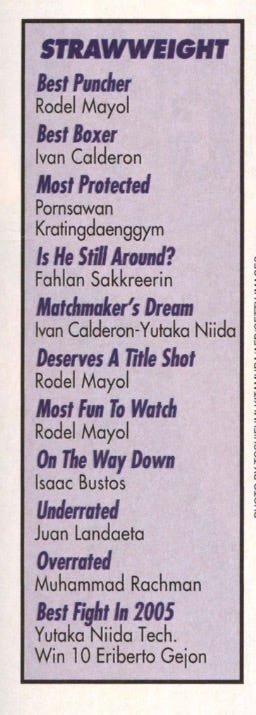
The Weight Class: Minimumweight, 2006
The Weight Class emphasises the minimumweight division of 2006!

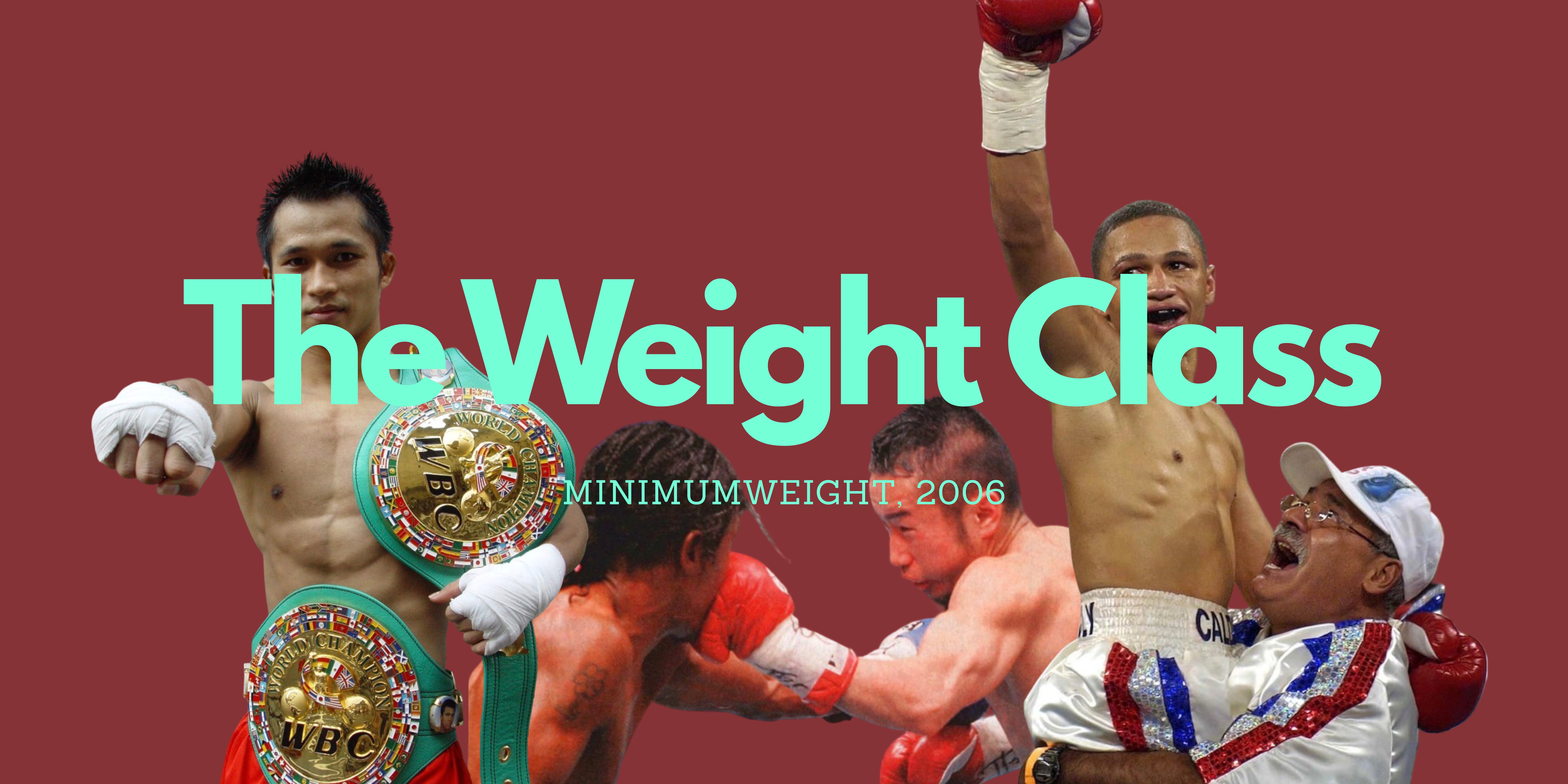
Image Courtesy of Eight Count.
Introduction
Twenty years ago, this sport was defined by the figures, fights and events discussed in BoxingScene’s Year-End Awards for 2006.
Manny Pacquiao (62-8-3) was their Fighter of the Year, whilst Andre Berto (32-6) was their Prospect of the Year. Argentina’s Carlos Baldomir (49-16-6) was also a figure of note, having won against Zab Judah (44-10) in their WBC World Welterweight title contest. Daniel Ponce De Leon (45-7) executed Thailand’s Sod Looknongyangtoy (64-3-1) within one, whilst Somsak Sithchatchawal (60-4-1) and Mahyar Monshipour (31-4-2) waged war in their Fight of the Year for the WBA World Bantamweight title. This was a renaissance.
It was throughout this year that even the most undervalued and neglected of divisions was the regular recipient of the spotlight, as the minimumweight division was one in flux. This month, twenty years ago, there were two contests featuring world titles and numerous changes to the status of the weight class.
The Weight Class is a series that allows Eight Count to traverse the depths of some of the lesser respected divisions at various points in their history. In this inaugural iteration, Eight Count emphasises the minimumweight class, as it existed twenty years ago, in 2006, using The Ring Magazine as a reference.
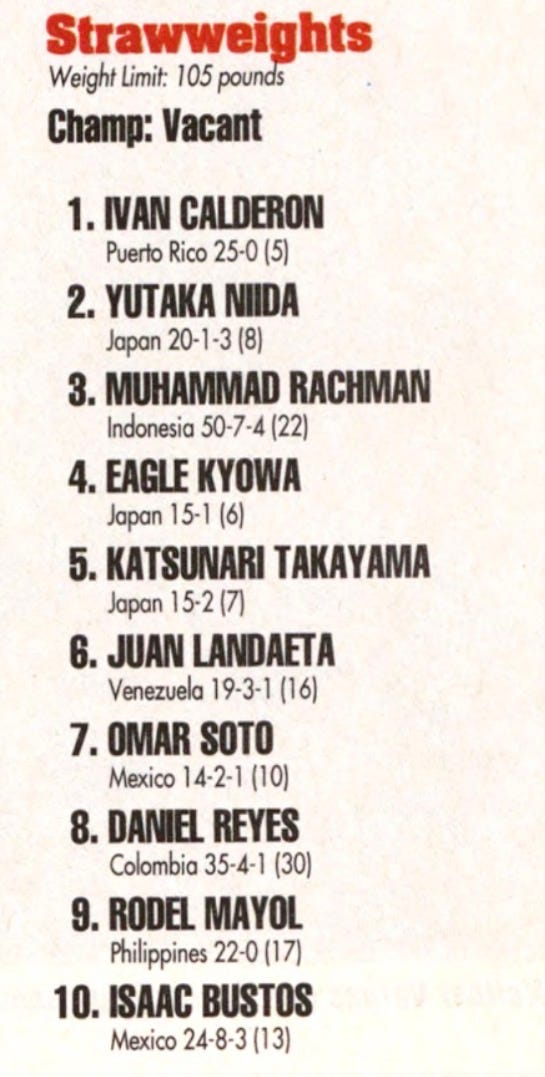
Ivan Calderon (25-0, 5KO)
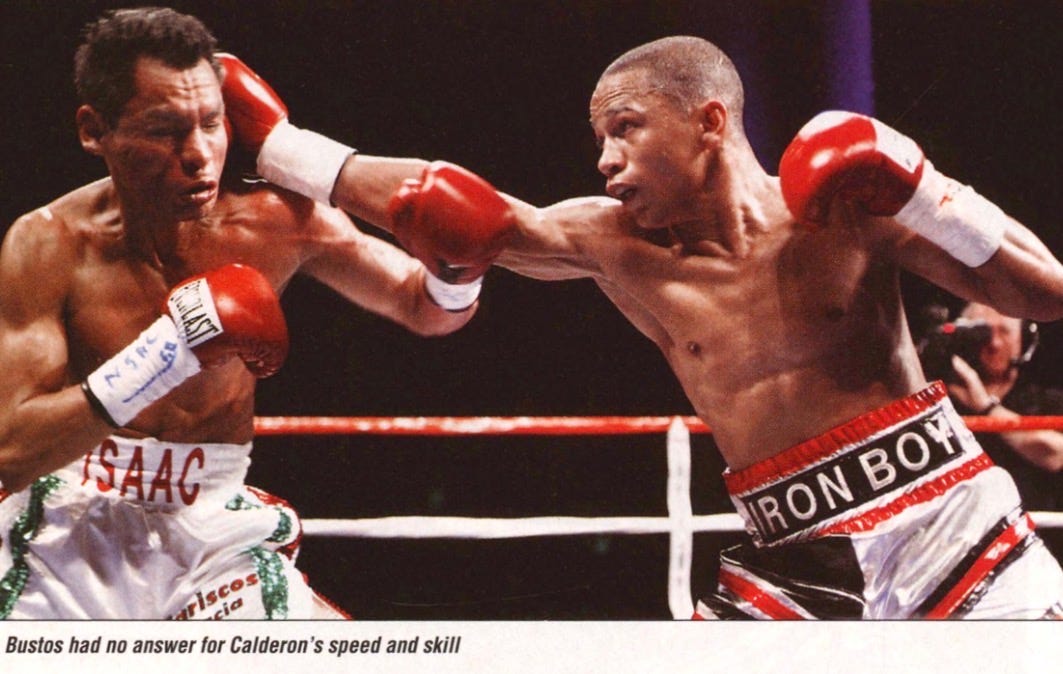
Puerto Rico’s Ivan Calderon was something of a generational fighter, at minimumweight. In fact, Calderon is held in the same esteem as Ricardo ‘Finito’ Lopez (51-0-1), the greatest single fighter that the division had ever seen.
Certainly, a position of high praise.
Of course, Calderon was not a puncher by any means, with the false moniker of ‘Iron Boy’. In his initial defence of the year, against fierce Mexican Isaac Bustos, this was apparent, even with Calderon leaving with a wide decision. This was Calderon’s tenth contest involving the WBO World Minimumweight title and his first of three defences within the year.
Puerto Rico would host their own, as Calderon scored a rare stoppage against Miguel Tellez (20-24-1) in the ninth, before concluding the year with a visit to Colombia to beat challenger Jose Luis Valera (15-12) via unanimous scores.
The soft slaughter of Isaac Bustos over twelve and the uncharacteristic violence of the win against Tellez produced quite a strong year, only reinforced with a win against a fighter with only one loss, which came via technical decision. It was indicative of a professional ledger which would only get stronger, with quite the eclectic list of wins in WBO World Light-Flyweight title contests, at the turn of the decade.
Calderon was certainly the greatest of the minimumweight division, in 2006, soon to become a great, without qualifiers.
Yutaka Niida (20-1-3, 8KO)
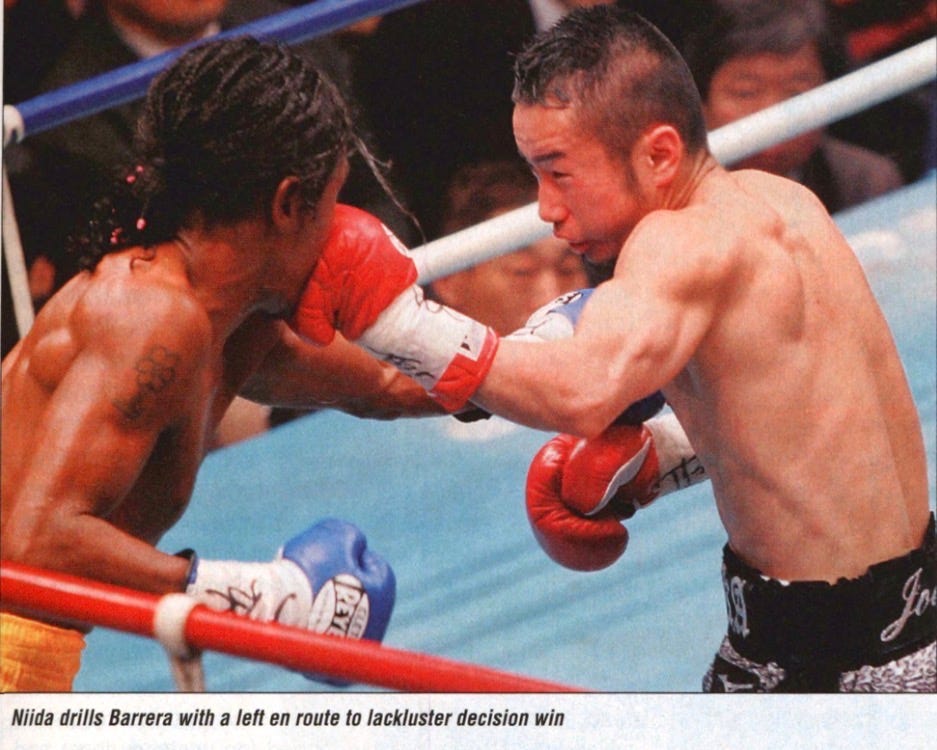
Joe Kozumi described Yutaka Niida’s year with one particularly apt word: lousy. In particular, such a year was the result of an uninspiring performance against Colombia’s Roland Barrera (30-14-2), a man who was not within The Ring Magazine’s selection.
It was Niida’s only appearance that year, with the strong counter-puncher falling in The Ring Magazine’s estimation, as a result of the tepid victory in Tokyo’s Korakuen Hall. A further win in 2007 - a split-decision over Katsunari Takayama - was not the antidote to such a poor performance. Nor as the eventual loss of Niida’s world honours, against the great, Hall of Fame Nicaraguan Roman ‘Chocolatito’ Gonzalez (53-4) in 2008. That would also become the retirement of Yutaka Niida.
Certainly, the year of 2006 was a nexus point for Niida, who was recognised as a participant in The Ring Magazine’s minimumweight fight of the year against Eriberto Gejon (25-5-1). Performances became lesser and those with genuine intentions began to assume Niida’s position within the leagues of the division.
Lousy was a charming description, in contrast.
Muhammad Rachman (50-7-4, 22KO)
Muhammad ‘The Rock Breaker’ Rachman was in the midst of a title reign as IBF World Minimumweight champion, throughout 2006. However, it was not a particularly pleasant one with the spectatorship, as The Ring Magazine declared ‘The Predator’ Rachman as the Most Overrated amongst the depths of the division.
After procuring the title from Daniel Reyes in 2004, via split-decision, Rachman made one voluntary defence against a man who once held the same title in Thailand’s Thongchai Utaida (54-4-3). It was a technical draw.
This year, however, was a surprisingly strong one for Rachman, who won both of his title contests via knockout. Omar Soto (23-12-2) was the IBF mandatory challenger and one who lost in six, whilst Benjie Sorolla (24-18-3) went one further, despite his poor record.
It was, by all means, the last great year of Rachman’s time as a fighter, losing his belt soon after. Underwhelming for an Overrated.
Eagle Kyowa (15-1, 6KO)
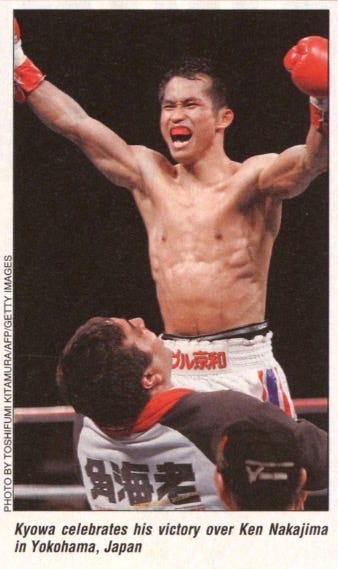
Thailand’s export to Japan, Eagle Kyowa, was the WBC World Minimumweight titleist and a man collecting quite the resume, given the general landscape of the era.
At the conclusion of the halfway point of the decade, Kyowa won the belt against Takayama, after previously losing it to Isaac Bustos. This year, then, was a strong reignition of Kyowa’s reign, with three contests and three victories.
Japanese national level fighter Ken Nakajima (16-5) fell easily in the seventh, reintroducing Kyowa to the concept of a stoppage, as the Thai fighter had not produced one since his early years. Afterwards, Kyowa fought in the greatest contest of his twenty fight campaign.
At Japan’s Korakuen Hall, Kyowa won a tight unanimous decision against the unbeaten puncher Rodel Mayol, a fighter considered by many as the oncoming threat of the division. The bout stands as a masterpiece of the minimumweight division. It was extraordinary.
Not content with ending the year in such a way, Kyowa would also win out in another classic one against Lorenzo Trejo (34-33-1). Certainly, Kyowa had a much stronger year than any other champion in the roster, with both the level and activity positioning Kyowa rather high.
Soon, however, Kyowa would lose once more, with only one further win on his resume. More about Kyowa’s resume can be seen in our Resume Review.
Katsunari Takayama (15-2, 7KO)
Katsunari Takayama was in the relative infancy of a professional tenure that would span over the duration of forty-five fights and over twenty years within the ring, over which Takayama would collect numerous world honours. In fact, Takayama held, at one point or another, every major sanctioning body belt, plus the IBO World Minimumweight title for an additional reign.
This year was one of frustration, however, as Takayama won… via two technical decisions. These were valuable wins, providing Takayama with the Japanese Boxing Commission’s Japanese Minimumweight title and a positive result against fringe contender Carlos Melo. Together, they provided the means for another shot at world titles… this being the previously mentioned split-decision on Niida’s ledger.
Quite frankly, this year was not indicative of Takayama’s wider abilities and longevity in the sport, as the Japanese fighter was not yet a dominant contender in the division, despite briefly holding the WBC World Minimumweight title, after his encounter with Isaac Bustos.
Juan Landaeta (19-3-1, 16KO)
Ronnie Nathanielsz wrote an article on the 8th of August 2006, which described the year of Juan Landaeta in quite a simple way: Another Hometown Decision In Japan. However, in July, Landaeta was considered The Ring Magazine’s Most Underrated, with the potential to mount an assault on the WBA World Minimumweight title, after a title-elimination victory over Carlos ‘Shangai’ Melo (22-22-3).
One month later, Landaeta’s trajectory became vastly different, with an opportunity coming via the light-flyweight division of 108lbs. At only nineteen years of age, Koki Kameda (33-2) was matching the record of other Japanese greats, in acquiring world honours at an early juncture in their tenures. Landaeta was to be the opponent that provided Kameda with the physical honours.
Two contests resulted in two controversies. In fact, it was such a source of controversy that Japanese spectators sent their apologies to the Venezuelan embassy and it was described as a stain, by Japanese publications. Either way, The Ring Magazine’s Underrated ‘Baby’ would not fight at the weight again, despite having further chances at subsequent weights.
Omar Soto (14-2-1, 10KO)
Often, this sport is one in which the status of contender is given, rather than earned through genuine recognition. Omar Soto of Mexico, however, won his shot at world honours via successive achievements.
The Mexican Minimumweight title-holder with a unanimous decision win in an IBF World Minimumweight title-eliminator contest, Soto was a worthy and deserving challenger, with fourteen wins, two losses and one draw.
This was a year in which that progress was burnt and withered, as Soto’s shot against Rachman ended via stoppage on away soil. Unlike Landaeta, Soto’s decision to pursue opportunities at higher weights was not a decision that bore successes; Soto’s other appearance during the year was a loss to Gilberto Keb Baas (35-22-4) in their North American Boxing Federation Flyweight title competition. An additional loss would over eight would welcome Soto to 2007.
That being said, Soto would challenge for numerous world titles at higher weights.
Daniel Reyes (35-4-2, 30KO)
Daniel Reyes was known as ‘El Olimpico’, after his participation in the 1996 Atlanta Olympics. The professional leagues, however, were far more challenging for Reyes, with his three title disputes ending in defeat.
This year was a quiet, almost routine, one for Reyes, who previously failed to usurp Calderon for the WBO World Minimumweight title in the late stages of 2005. Two positive points wins against nondescript opposition saw Reyes transition to the light-flyweight division, where Reyes would score a result against previous world title-holder Nelson Dieppa (25-5-2).
Either way, it was quite some time before ‘El Olimpico’ dropped to 105lbs once again.
Rodel Mayol (22-0, 17KO)
Rodel Mayol was the danger of the division, at the time. An unknown quantity with serious intentions and an immense knockout ratio, Mayol was the primary challenger at the weight, recognised as the Best Puncher, the Most Fun To Watch and The Most Deserving Of A Title Shot by The Ring Magazine.
Although, this perception of Mayol was unique to the initial half of the year, rather than the concluding portion. Later in the year, after obliterating Lorenzo Trejo over four in a title eliminator, Mayol would come out of his challenge of Eagle Kyowa’s title without the belt, albeit producing an exceptional effort.
Rather than ending the year on this lull, Mayol travelled to Japan to finish Masatsugu Okada (8-11-3) within a single stanza. Unlike many of the others on the list, it was a performance that was indicative of Mayol’s further success in the sport, with numerous title challenges at light-flyweight and an eventual world title victory against Edgar Sosa (54-11).
It was a devastating year for Mayol, in every sense of the word.
Isaac Bustos (24-8-3, 13KO)
Every division has a strong, tough and resilient Mexican with the aptitude to contest against those with world honours. At this point in time, it was the indestructible Isaac Bustos that fought in this particular way, collecting that particular reputation - and a surprising rule as a world title-holder in the process.
At the turn of the century, Bustos transitioned from the role of the journeyman to an actual, full contender. Win after win saw Bustos steal the WBC World Minimumweight title away from Eagle Kyowa in 2004, whilst also losing that title to Katsunari Takayama in 2005. That was the height of his time as a professional, with 2006 seeing Bustos lose in a one-sided one against Ivan Calderon. Only one more win came, along with two losses.
Toughness, after all, can only carry one for so long - even in a weight class like 105lbs.
The Landscape
This was a duration of interest for the division, particularly given the absence of someone like Ricardo ‘Finito’ Lopez to rule as an elite. Ivan Calderon held the highest position, as a truly great fighter whose attributes provided a transition into a two-weight title run at 108lbs.
Whilst Yutaka Niida was on the decline, Eagle Kyowa was in the midst of a positive reign and Muhammad Rachman was soon to lose any sort of world honours and become more of an opponent. There were changes amongst the championship lineup. At the time, Rodel Mayol was predicted to join them within the major title picture; Eagle Kyowa kept the Filipino away from these ambitions in their savage contest for the WBC World Minimumweight Championship.
Many of these fighters were also in a state of decline; Isaac Bustos, Daniel Reyes and Omar Soto had all reached their pinnacle, whilst others were waiting to reach their positions.
The Ring Magazine’s Matchmaker’s Dream never came to pass, as Ivan Calderon and Yutaka Niida never fought, in what would’ve been a WBA & WBO World Minimumweight title unification, with The Ring Magazine Championship also on the line.
Eight Count’s Minimumweight List (2006)
#1 - Ivan Calderon
#2 - Eagle Kyowa
#3 - Yutaka Niida
#4 - Rodel Mayol
#5 - Katsunari Takayama
#6 - Muhammad Rachman
#7 - Juan Landaeta
#8 - Daniel Reyes
#9 - Omar Soto
#10 - Isaac Bustos