
The Volatile: Mayorga Vs. Vargas
Two of the most colourful figures of the 2000's came together in a WBC Continental Americas attraction at the Staples Center.

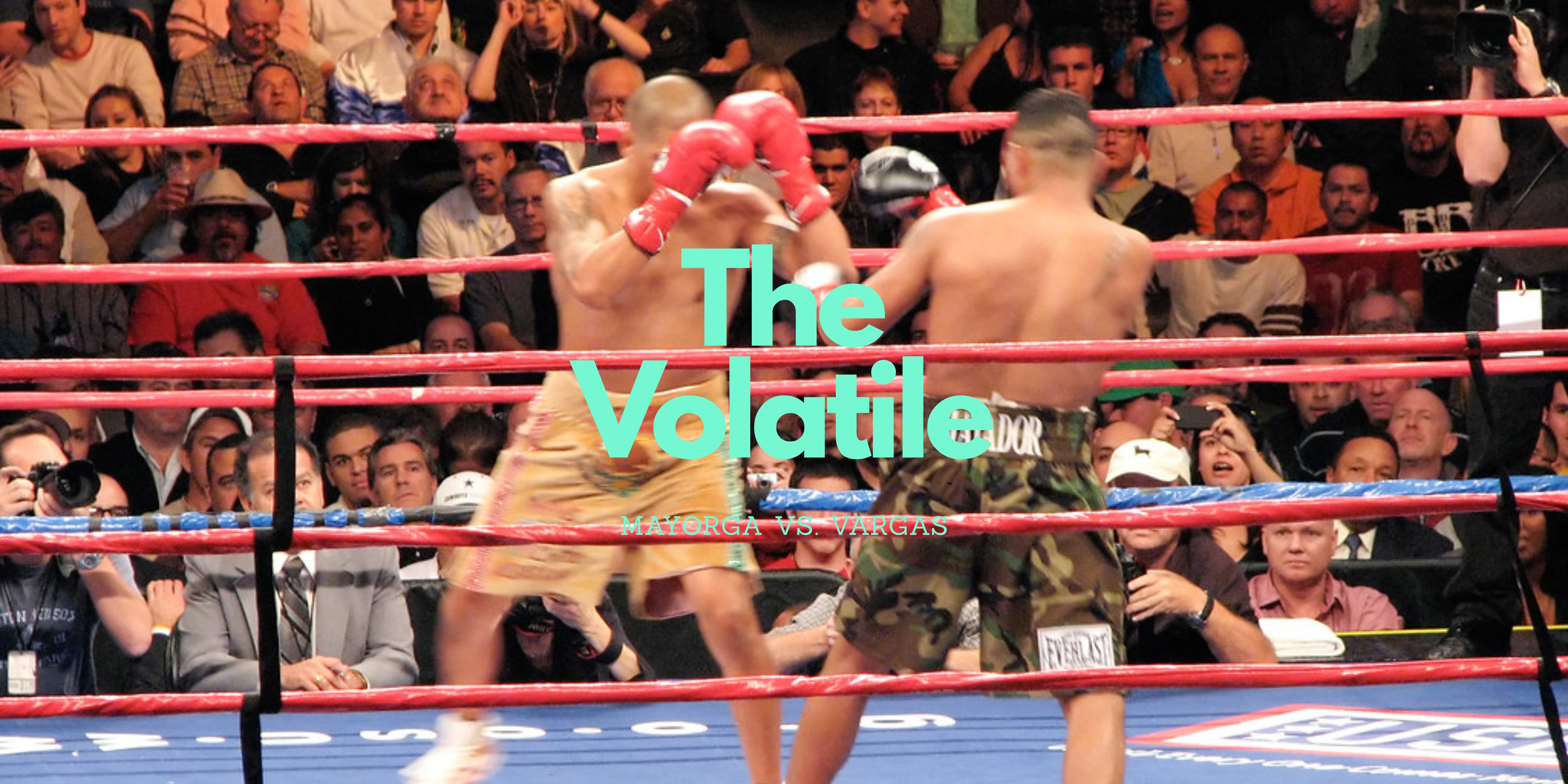
Image Courtesy of Eight Count.
The buildup was ugly. The fight was a beauty.
These were the words written by ESNP in the immediate aftermath of Ricardo Mayorga (32-12-1, 1NC) versus Fernando Vargas (26-5) in their contest for the WBC Continental Americas Super-Middleweight title on the 23rd of November 2007 at the Staples Center.
They still remain the most apt way to open any discussion on such a volatile, vicious conflict, as they capture the exhaustive, uncomfortable beauty that both men provided throughout their encounters; not only during their endearing competition, but in any proximity to one another.
Although, the fact that such a contest even happened is a rather curious thing; a grotesquely-beautiful thing.
Fernando Vargas was, at ten years in the professional sphere, an entirely different man from the one that made his debut at nineteen years of age; at twenty-nine, Vargas was a man of accumulation, with wounds and wars worn across his skin.
At the age of twenty-nine, Vargas had both held and lost the IBF, WBA and IBA World Super-Welterweight titles and fought against some of the most generational figures in the lineage of the 154lbs weight division; the likes of Californian rival Oscar De La Hoya (39-6), Ghanian ‘Bazooka’ Ike Quartey (37-4-1) and Puerto Rican paragon Felix ‘Tito’ Trinidad (42-3).
Each and every contest was a strain on the body; perhaps, the ferocious nature of ‘Ferocious’ Fernando Vargas was more of a curse than an attribute. In the twilight years, Vargas also blew up in weight between fights, becoming less disciplined and athletic. Of course, this is not conducive to a championship boxer.
The scales became more of an enemy than any ring opponent. The demands of family life, with children and investments becoming more of a presence. The injuries and quality of Vargas’ own physique were also plagues upon the previous titleist.
Certainly, there was no doubt that Vargas was in the closing chapter. Although, given the deluge of belligerence both inside and outside of the ring, there was no doubt that it would become the most volatile chapter in the entire story.
In that sense, the introduction of Ricardo Mayorga was more than a formality, but a necessity.
Ricardo Mayorga had, through years of unknown brutality, received the reputation of a vile, vulgar character, known for unsavoury activities, outbursts of obscenity and a general aura of something more sinister than the usual hostility seen in prizefighters.
Known as the craziest man in the sport, according to The Ring Magazine, Mayorga was an offensive spirit, both in the ring and in public appearances, where insults and fists flowed with a sense of unique freedom, only known to those with a particularly unhinged mindset.
At this stage, Mayorga was also a two-weight titleist, putting in performances that are notorious. In furious fights, Mayorga overcome Vernon Forrest (41-3) in a WBC World and The Ring Magazine Welterweight title duology and win the vacant WBC World Super-Welterweight title against Italian ‘Gentleman’ Michele Piccirillo (50-5).
Although, against the elite, Mayorga was disarmed; Trinidad and De La Hoya both gave the Nicaraguan TKO losses. These were performances meant to silence the inflammatory Mayorga.
There was a need for an opponent with more of a ferocious flair; it was a collision of two eruptive, inconsistent threats.
In May of 2007, it became known that Ricardo Mayorga and Fernando Vargas would contest one another in a professional ring; it was more of a grudge match, than anything else. No major titles were on the line.
On the 11th of July, there was a press conference to announce the fight, which Mayorga sought to use as another avenue through which to insult, belittle and abuse his opponent; Mayorga insulted the weight of Vargas - as their contest would be fought at a 162lbs catchweight, owing to Vargas weighing at 264lbs prior and suffering with iron issues - as well as directing remarks at Vargas’ wife.
These were challenged by Vargas, as the two men came to an early exchange. Vargas, after Mayorga had been escorted out, emphasised that this would be a fight contested over pride and little else; in fact, win or lose, it would be the last anyone would see of Fernando Vargas in the ring.
The initial date of the 8th of September came and passed without incident; Vargas was diagnosed with anemia and the fight was rescheduled to November, allowing for recovery time. Certainly, it also gave both men more time to fuel their disdain of one another.
Both men eventually weighed in at 164lbs, an unknown weight for both; Vargas was the #14 in the WBC Super-Welterweight leagues, whilst Mayorga sat one below at #15. As customary for the sanctioning bodies, the World Boxing Council put their WBC Continental Americas Super-Middleweight title on the line, although, as Vargas stated, there was more on the line than a mere belt.
It was about pride, something more volatile and mercurial.
Ricardo Mayorga Vs. Fernando Vargas - WBC Continental Americas Super-Middleweight
Friday 23rd November 2007 - Staples Center, Los Angeles, California, U.S.A.
The atmosphere was synonymous with this particular era of the sport, as the masses gave their support for two men with personalities that could not be contained by a ring or, for that matter, the entirety of the Staples Center.
More so than that, those spectators had also bore witness to a rather tight undercard, with some genuinely great contests at multiple levels of the sport.
Those privy to the earliest contests saw three fights staged over the duration of eight; Nicaraguan Evans ‘The Sandman’ Quinn (20-6-1) beat Victor Barragan (12-11-1) with little resistance in under three minutes, whilst Nelson Linares (20-0-1) and Henry Crawford (22-2-1) captured victory over the distance.
Two non-title ten stanza contests were also seen, with Fernando Angulo (29-10) going the distance against Detroit’s Damian Fuller (30-8-1) and ‘The American Boy’ Jason Litzau (30-3-1) seeing out the distance against tough Mexican Edel Ruiz (30-23-4).
A WBA World Super-Welterweight title-eliminator ended rather early, with Roman ‘Made in Hell’ Karmazin (40-5-2) knocking out Alejandro Garcia Hernandez (26-6-1) in only the third stretch. In the following year, Karmazin would lose the title opportunity after a loss to Alex Bunema (31-10-2).
The major world title attraction of the night came at welterweight, with Kermit Cintron (39-6-3) in defence of the IBF World Welterweight title against IBF USBF Welterweight holder Jesse Feliciano (15-10-3).
Feliciano gave a strong account but was clearly outmatched by Cintron, who was able to overwhelm the non-descript Feliciano in the tenth. Either way, it was a great accompaniment. It was, after all, something volatile; although, not as ill in intent as the catchweight main feature.
The contest was given the sparse title of The Brawl and their initial contact gave it all the substance such a minimalist title must require, as Mayorga threw without shape and form, but with the sort of malice that ‘El Matador’ constructed a persona through.
Vargas, without the erratic hair that once caught the eye and with the extra weight that clearly sat in the wrong areas, was lethargic, slow and sedate in pace.
In military camouflage shorts, Mayorga cut a more militant figure; clearly, the Nicaraguan wore the weight with authority and it accentuated the violent pedagogy of Mayorga to a greater degree. It was likely that, with Mayorga’s more strong output, Vargas was losing weight.
With only twenty-two seconds in the opening, Mayorga assaulted Vargas in one of their furious exchanges, rupturing Vargas to the canvas. It was an ill sign.
At the end of that duration, Vargas sat on his stool with heft, as though the burden of the fight and those prior antics sat heavy on his shoulders. Of course, the knockdown did not help. Mayorga threw his fist in the air whilst standing on the ropes; it was a sharp contrast.
The contrast was, in many ways, evocative of a passing of the torch.
Mayorga, to the dismay of Raul Caiz Jr., the acting referee, threw taunting gestures at the two-time super-welterweight champion. Alongside, of course, punches.
More comfortable than the prior round, Vargas was able to execute some shots, even if it was a much slower round that Mayorga edged through selective output and flurries.
At the onset of the third, Fernando became ‘Ferocious’ Fernando, launching into Mayorga. Again, Vargas was able to execute and, even, lead some exchanges, although Mayorga was more meaningful; it was one ageing man against a militia of pugilistic strength.
Unfortunately for Vargas, the artillery would soon hurt more than a mere punch, as a cut opened close to the eye; it was another sign that the body was giving in whilst the mind was prepared for more. Mayorga, fresher, could give more.
In the fourth and fifth, it was Mayorga who was opening exchanges, although Vargas always threw and, more often than not, ended them with a sightly punch. Still rough and undisciplined, Mayorga was boxing and doing so with more restraint than exercised prior.
That was also an approach that sought to lure Vargas into the true onslaught; the very one worthy of the tagline The Brawl.
The military threw every bomb available, as Mayorga threw body shots, overhand shots and uppercuts with serious intent, throughout the duration of the seventh.
These hurt Vargas, who was the most mobile the Oxnard native had been throughout the entire fight, to that point. The responses were not as threatening as the initial insult, as Mayorga was clearly the stronger man at the weight.
In particular, the slinging left hand of Mayorga also became an issue for Vargas, who waded with a sense of discouragement. Perhaps that was the exact moment any pride within Vargas was extinguished, under the slaughter of Mayorga. Of course, whilst not consistently at a high volume, these shots simply had more to offer than any given by Vargas.
Again in the eighth, Vargas was an unwilling participant in Mayorga’s military demonstration, as the Nicaraguan threw as many punches as he would later smoke cigarettes. At the end, however, Vargas threw a punch that caught Mayorga clean; it was the first punch that genuinely sent Mayorga on the retreat.
The bell was his saviour.
They kept it close in the ninth, with Vargas able to collect enough spirit to throw with belligerent body shots that banged upon a more static Mayorga. Vargas became the aggressor, if only for a few minutes.
In the tenth, Mayorga sought to re-pay the favour and both men went into the trenches; the weight was, again, an evident factor. The eleventh protracted this conflict, with their prior skirmishes giving way to a more sustained, attritional sort of dispute.
Again, the fleeting seconds of a round proved to be the most pivotal, as a loaded right hand caught Vargas on the chin, resulting in the second knockdown of the contest. Once more, the beating took a toll on the body of the Olympian.
In that sense, the twelfth and final round of Fernando Vargas’ professional tenure was one fought with pure ferociousness, as the former IBF, WBA and IBA World Super-Welterweight titleist made a last stand; not for the WBC Continental Americas Super-Middleweight title, but for pure pride.
It was one that he won, with aggression and pace providing the decider. Although, winning the battle does not win the war in the sport of boxing.
Max DeLuca scored the contest 115-111 to Mayorga, with Glenn Trowbridge giving a 114-112 margin to the same fighter. These cancelled out the 113-113 given by David Mendoza. By majority decision, Ricardo Mayorga won The Brawl.
Fernando Vargas was an honest man.
In the aftermath, Vargas kept his word and never entered the ring as a prizefighter again. Although, Vargas left with pride, as Mayorga acknowledged the innate desire of ‘Ferocious’ Fernando via raising the arm of the losing man.
In the years since, Emiliano Vargas (15-0), Fernando Vargas Jr. (17-0) and Amado Vargas (13-0) have come onto the scene and at least two of them have demonstrated a similar aptitude for the sport; they each carry that pride that Vargas left with that night in November of 2007.
Mayorga would never capture another world title, sustaining a loss to Puerto Rico’s generational Miguel Cotto (41-6), as well as two losses to ‘Sugar’ Shane Mosley (49-10-1) that became pillars of Mosley’s legacy as a fighter.
Certainly, the pride of Mayorga that night might run through the veins of Martinez, who contends with Christian Mbilli (29-0) in a collision of the upcoming generation.
Either way, the echoes of this particular fight are not as volatile as the initial build-up and fight itself; there is a sense of pride that lingers in the contemporary landscape of the sport and those with a deep connection to both men.
The volatile gives way to something more pure and honest: pride.
A great write-up from a different era. I remember Mayorga slurring Vargas' wife and Fernando going for him, yelling about nobody insulting his queen. Vargas burned brightly but burned out fast. He was heavy and undisciplined by this point. Mayorga labelled him "fatty" from the mic stand.